
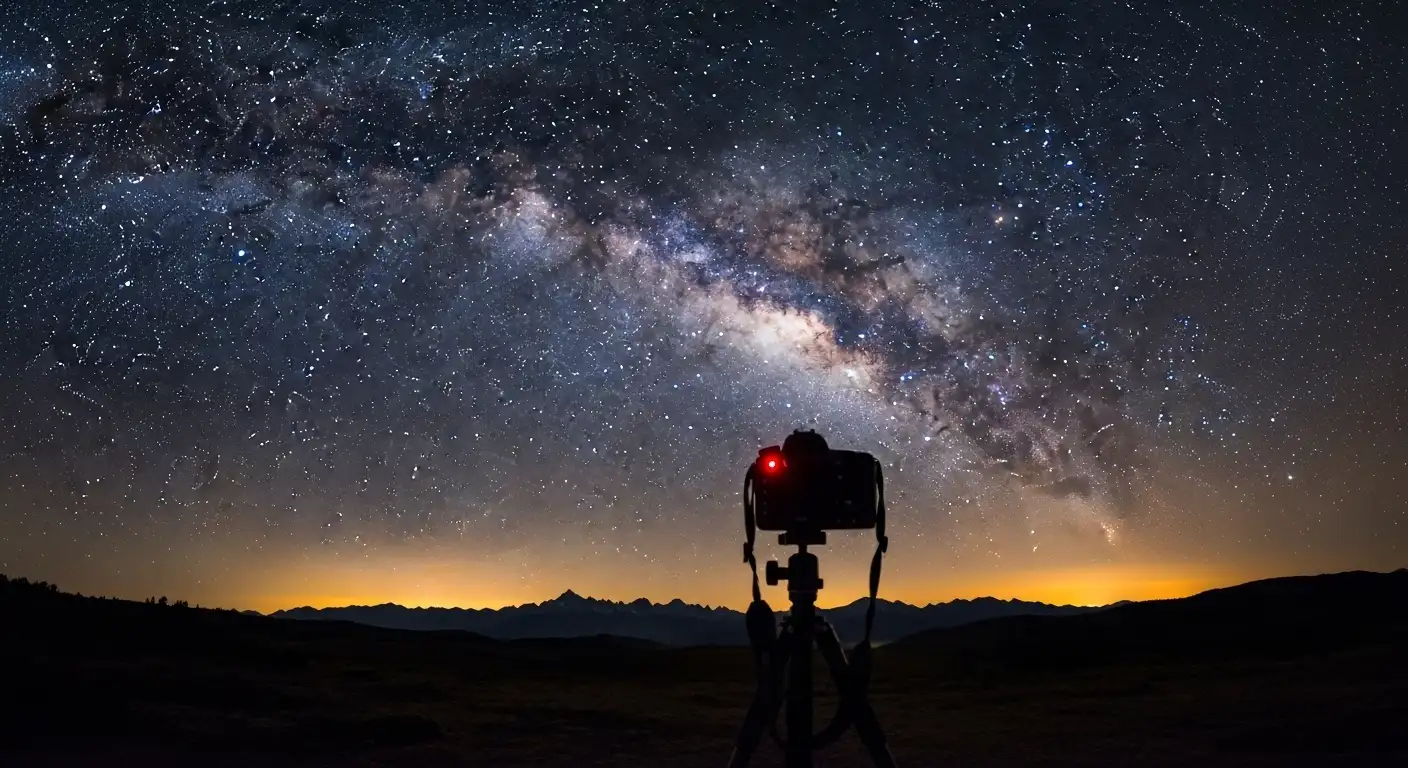
How Do I Set Up a DSLR to Take Photos of the Stars? Star photography is an exciting hobby, but beginners often get blurry or dark shots. The secret is mastering ISO, aperture, and shutter speed, using a tripod, wide-aperture lens, and manual focus.
Choose a dark location, check the moon phase, and shoot in RAW for best results.
This guide will show you step by step how to capture the Milky Way and night sky with any DSLR—Canon, Nikon, or Sony—so your star photos turn out sharp and stunning every time.
How Do I Set Up a DSLR to Take Photos of the Stars?
To set up a DSLR to take photos of the stars, mount your camera on a sturdy tripod, switch to Manual mode, set a wide aperture (f/2.8 or lower), adjust ISO between 1600 and 3200, and use a shutter speed of 15–25 seconds based on the 500 Rule. Manually focus the lens to infinity using Live View, shoot in RAW format, and use a 2-second timer or remote shutter release to eliminate camera shake. Choose a dark location away from light pollution and avoid shooting during a bright moon.
These exact steps ensure sharp stars, balanced exposure, and controlled noise in long exposure night sky photography. Below, we will break down each setting and configuration in detail so you can confidently photograph the night sky with precision.
Here is a quick cheat sheet before we dive into the details.
Best Settings at a Glance
| Camera Setting | Recommended Value | Why You Need It |
| Aperture | f/2.8 or lower | Lets in the maximum amount of light. |
| ISO | 1600 to 3200 | Makes the camera more sensitive to the dark. |
| Shutter Speed | 15 to 25 seconds | Gathers light over time without blurring. |
| Focus | Manual (Infinity) | Keeps the stars looking like sharp little dots. |
| File Type | RAW | Gives you the most detail for editing later. |
Let us get started with the nine essential steps.
Jump To Sections
1. Use a Stable Tripod for Long Exposure Stability
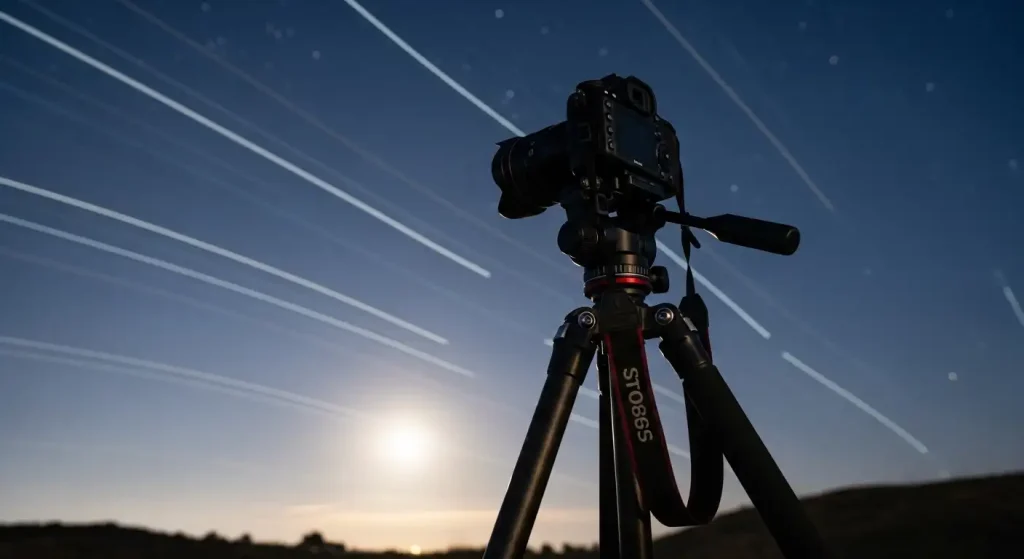
When you shoot stars, the shutter on your camera needs to stay open for a long time. This is called long exposure photography. Because the shutter is open for 15 to 30 seconds, any tiny movement will make your stars look blurry.
You must use a heavy, stable tripod. A cheap plastic tripod might shake in the wind. If you only have a light tripod, try hanging your camera bag from the center hook to add weight.
Also, make sure to turn off image stabilization on your lens. When your camera is on a tripod, the stabilization feature can actually create tiny micro-vibrations that ruin your shot. For the best camera shake reduction, lock your tripod legs tight and turn that setting off.
2. Select a Wide-Angle Lens for Maximum Sky Coverage
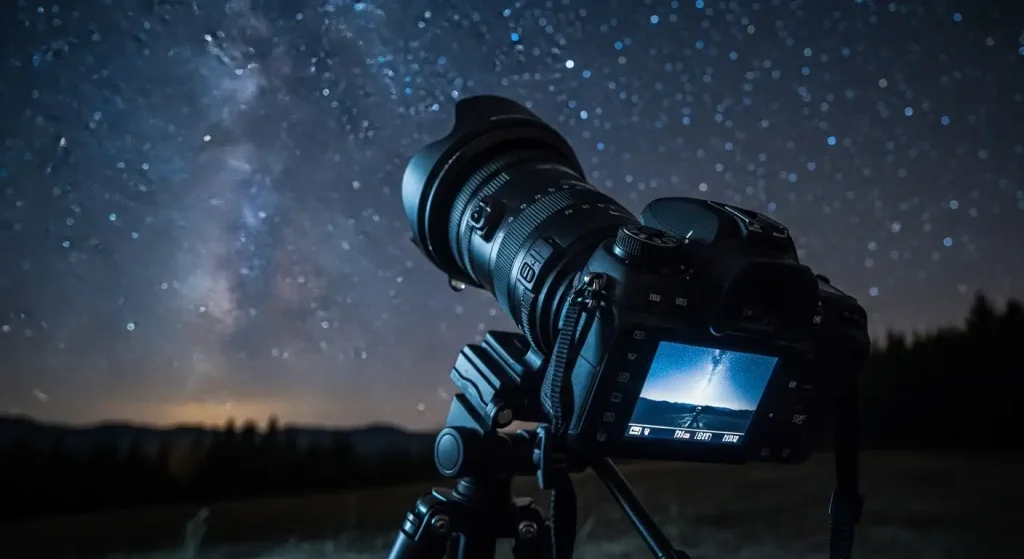
To capture the vast beauty of the night sky, you need to see as much of it as possible. This is why a wide aperture lens is the best lens for night sky photography.
You want a lens with a short focal length. A range between 14mm and 24mm is perfect. This lets you fit the whole Milky Way and some of the ground into one picture.
You also need to understand the difference between a full-frame camera and a crop sensor camera. If you have a crop sensor, your lens will look more zoomed in. A 14mm lens on a crop sensor acts like a 22mm lens. It is still wide enough, but it is something to keep in mind when setting up your shot.
3. Switch to Manual Mode for Full Exposure Control
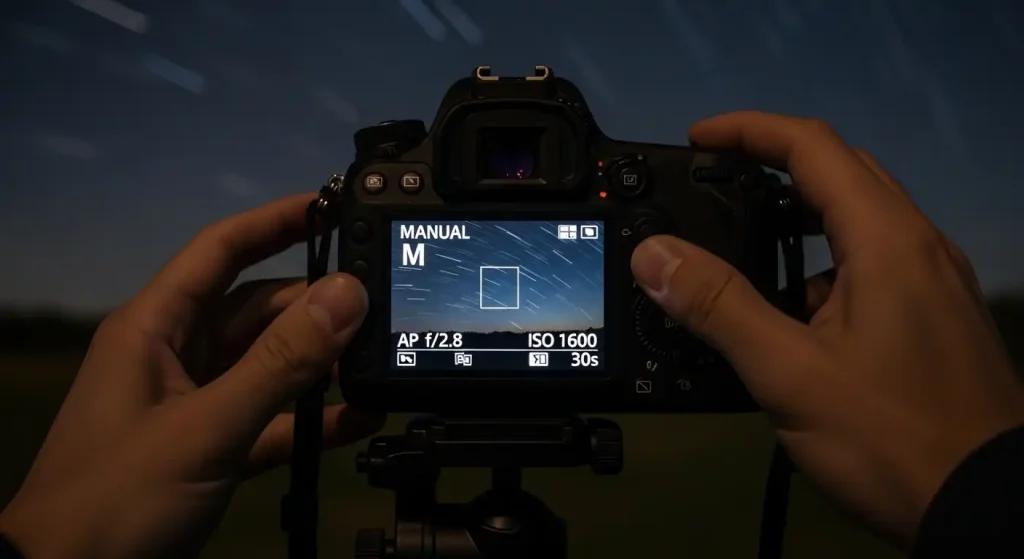
When you take pictures during the day, your camera does a great job guessing the light. At night, the camera gets completely confused. Auto mode will fail every single time.
You must turn your camera dial to Manual Mode (M). This gives you total control over the exposure triangle balance. The exposure triangle is made up of three things:
- Aperture: How wide the lens opens.
- ISO: How sensitive the camera is to light.
- Shutter Speed: How long the camera takes the picture.
By using manual mode, you tell the camera exactly how to gather enough light to see the stars.
4. Set a Wide Aperture to Capture More Light
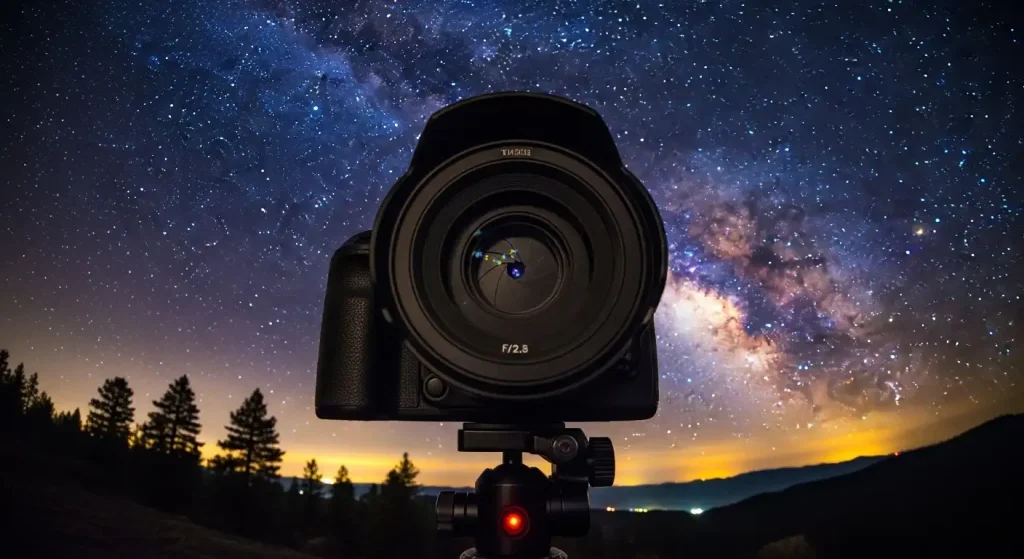
Your aperture works just like the pupil in your eye. In the dark, your pupil gets bigger to let more light in. You want your lens to do the exact same thing.
You need to set your camera to the lowest f-number your lens allows. This is called a wide aperture.
- If your lens can go down to f/1.8, use it.
- If it only goes to f/2.8, that is perfectly fine.
- Even f/3.5 can work if you adjust other settings.
A lower f-number means the hole inside the lens is larger. A larger hole lets in maximum light. This is one of the most important camera settings for stars.
5. Adjust ISO for Night Sky Sensitivity
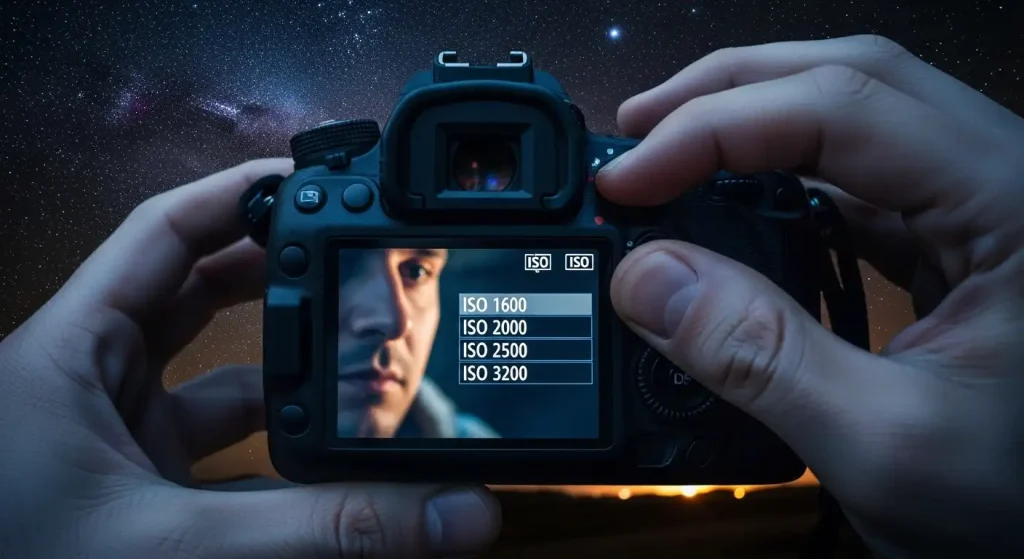
ISO controls how sensitive your camera sensor is to light. Because the sky is so dark, you need a high ISO setting.
For star photography, the best ISO for star photography is usually between ISO 1600 and ISO 3200.
There is a catch. When you raise the ISO, your picture gets brighter. But it also gets grainier. This grain is called high ISO noise. You have to find a good balance. If you use an ISO of 6400, the stars will be very bright, but the picture might look like a messy, grainy painting. Start at 1600. If the photo is too dark, move up to 3200.
6. Calculate Shutter Speed Using the 500 Rule
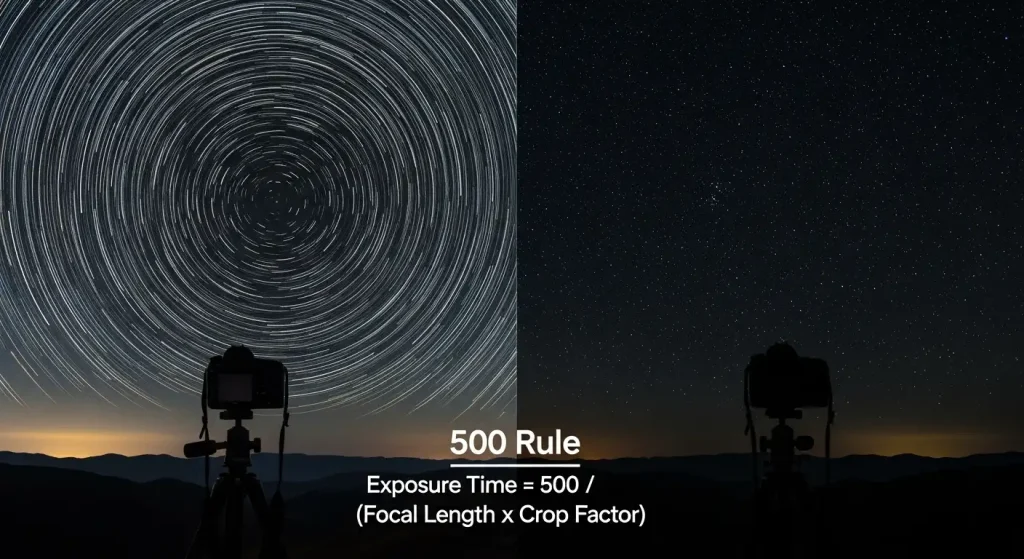
Because the Earth is spinning, the stars are always moving across the sky. If you leave your shutter open too long, the stars will look like long lines instead of sharp dots. This is called a star trail.
To figure out how to avoid star trails, you need to use a math trick called the 500 Rule. You simply divide the number 500 by the focal length of your lens. The answer is the maximum number of seconds you can leave the shutter open.
See also: What Are The Steps Follow To Become A Data Scientist 2026 Updated
Here is a simple table to show you how the 500 Rule works for a full-frame camera:
| Lens Focal Length | Math Formula | Maximum Shutter Speed |
| 14mm | 500 / 14 | 35 seconds |
| 16mm | 500 / 16 | 31 seconds |
| 20mm | 500 / 20 | 25 seconds |
| 24mm | 500 / 24 | 20 seconds |
Note: If you use a crop sensor camera, divide your answer by 1.5 to be safe.
7. Focus Manually at Infinity for Sharp Stars
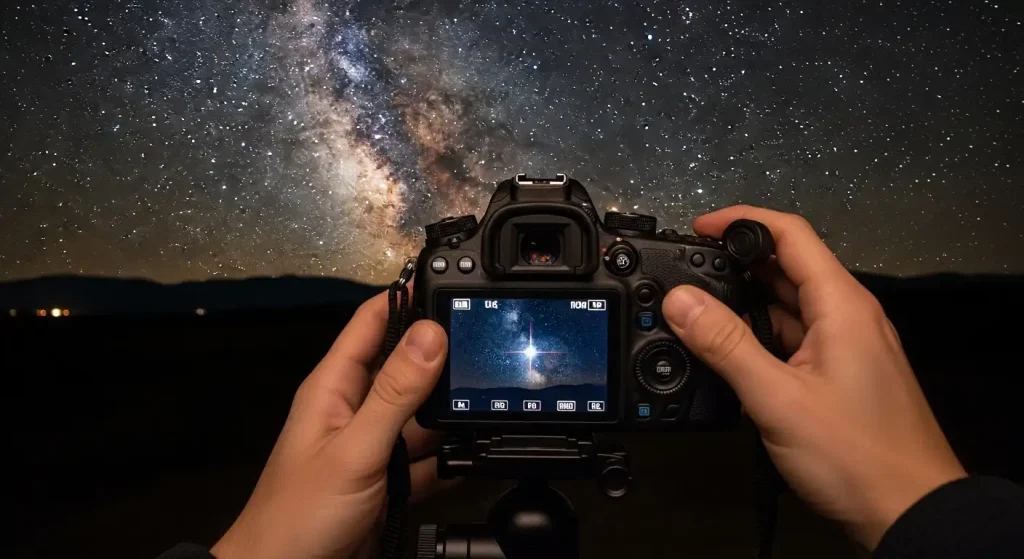
Your camera cannot use autofocus in the dark. It will just hunt back and forth and never lock onto anything. You must use manual focus mode.
You need to set your focus to the infinity symbol (∞) on your lens. But do not just turn the ring all the way to the end and stop. Sometimes the true infinity point is slightly before the end of the dial.
Here is the best infinity focus adjustment method:
- Turn on your camera screen (Live View).
- Point your camera at the brightest star in the sky.
- Use the plus button on your camera to zoom in on that star digitally.
- Slowly turn your manual focus ring.
- Stop when the star looks like a tiny, perfectly sharp pinprick of light.
This is exactly how you focus a DSLR at night.
8. Shoot in RAW for Better Post-Processing Flexibility
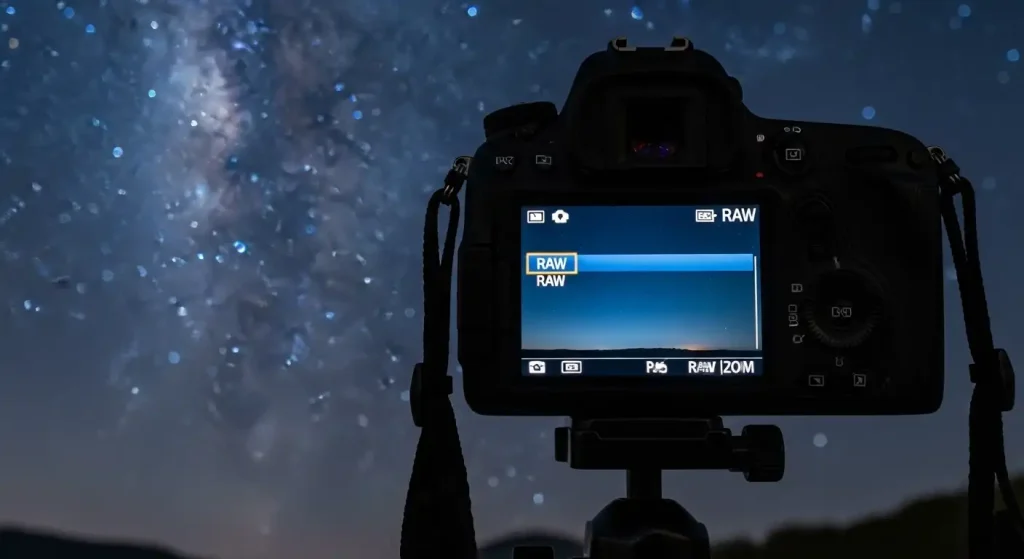
Every camera lets you choose the type of picture file it saves. Most people use JPEG for daily photos. For stars, you must use the RAW image format.
When you shoot a JPEG, the camera throws away a lot of color and light data to make the file smaller. When you shoot in RAW, the camera keeps absolutely everything.
You will need to edit your star photos later on a computer or phone to make the Milky Way really pop. A RAW file gives you massive post-processing flexibility. You can bring out hidden stars, fix white balance, and clean up noise much better than you ever could with a JPEG.
9. Use a Timer or Remote to Eliminate Camera Shake
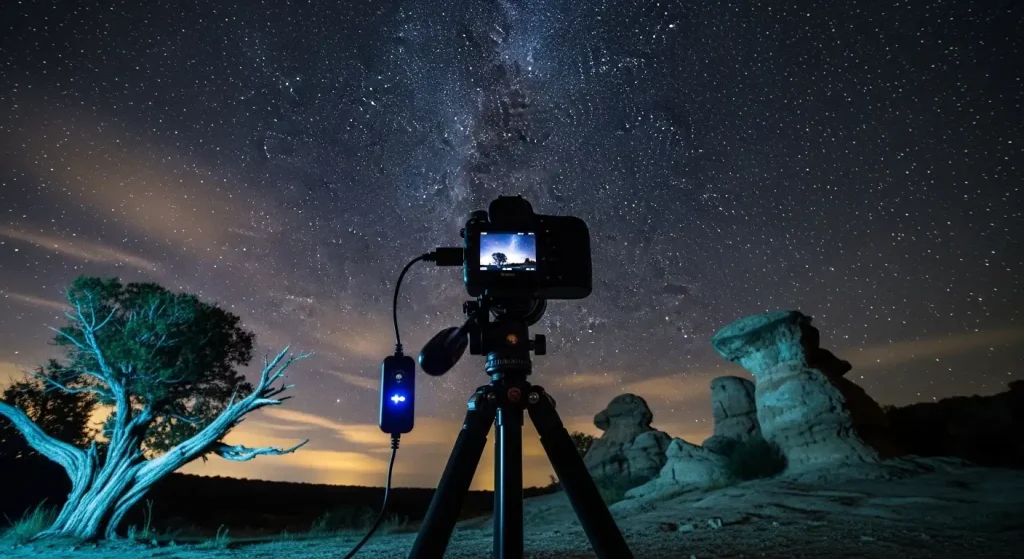
You have your tripod set up. Your settings are perfect. Now you reach out and press the button to take the photo. Guess what happens? Your finger pushing the button shakes the camera. Your stars are now ruined.
To fix this, you need to use a remote shutter release. If you do not have a remote, simply use your camera’s built-in delay timer.
Set a 2-second or 10-second timer in your menu. When you press the button, you can take your hands away. The camera will sit perfectly still for two seconds before the shutter opens. This gives you perfectly sharp stars every single time.
Preparation Before Photographing the Night Sky
Having the right star photography settings canon or Nikon cameras need is only half the battle. You also have to prepare for the environment. Here is what you need to do before you step outside.
Find a Location with Minimal Light Pollution
You cannot take good pictures of the stars in the middle of a big city. Streetlights and buildings create a glowing haze in the sky. You need to check light pollution levels and find a very dark place. Look online for dark sky maps to find a good spot at least an hour away from city lights. International Dark-Sky Association (IDA)
Check Moon Phase Before Shooting
The moon is basically a giant flashlight in the sky. If you try to shoot stars during a full moon, the sky will be too bright. The stars will be washed out. The best time for long exposure night photography is during a New Moon, or after the moon has set below the horizon.
Bring Extra Batteries in Cold Weather
Standing outside at night can get very cold. Cold weather drains camera batteries extremely fast. A battery that lasts four hours in the sun might only last one hour in the freezing cold. Always charge two or three extra batteries and keep them warm inside your jacket pocket until you need them.
Monitor Weather and Cloud Coverage
You cannot photograph stars if there are clouds in the way. Always check the weather forecast before you drive out to your location. Look for apps that show hourly cloud coverage. A completely clear sky is your best friend.
Complete Video Guide on How Do I Set Up a DSLR to Take Photos of the Stars?
Quick Answers to Common Questions
What Is the Best DSLR Setting for Star Photography?
The best starting setup is manual mode, an aperture of f/2.8, an ISO of 3200, and a shutter speed of 20 seconds. You must also shoot in RAW format and use manual focus.
What ISO Is Best for Photographing Stars?
The ideal range is between ISO 1600 and ISO 3200. This range is sensitive enough to capture faint starlight without introducing too much ugly digital noise into your final picture.
How Long Should Shutter Speed Be for Stars?
Your shutter speed should usually be between 15 and 25 seconds. If you leave it open any longer than that, the rotation of the Earth will cause the stars to streak across the image.
How Do You Avoid Star Trails Without a Star Tracker?
You avoid star trails by using a wide-angle lens and keeping your shutter speed under 30 seconds. To find the exact maximum time, you use the 500 Rule by dividing 500 by your lens focal length.
What Is the 500 Rule in Astrophotography?
The 500 Rule is a simple math formula used to prevent blurry stars. You divide the number 500 by your lens focal length. The resulting number tells you the maximum amount of seconds you can expose the photo before stars start to trail.
also Check :
- What Are The Steps Follow To Become A Data Scientist 2026 Updated
- 21 Science-Backed Tips for Better Sleep Quality: Improve Deep Sleep Naturally
- изменение параметров питания и спящего режима в windows (полный и понятный гид)
- iPhone 18 Charger: USB-C Type, Wattage, Price & Compatibility Guide
- How Do I Set Up a DSLR to Take Photos of the Stars? (9 Steps)
